The HTC Rhyme

The HTC Rhyme is something of a delicate matter, as it is HTC's firstphone that is said to have been designed with a female audience in mind. Yet it comes in dull colours and looks quite a lot like every other HTC handset we’ve seen so far.

PENTAX Q-REVIEW

Let’s get one thing straight from the start. The Pentax Q is quite an incredible camera to behold. It’s tiny. But not only is it tiny, it also looks great.

NIKON 1 V1

Nikon has announced two new compact system cameras: the Nikon 1 V1 and the Nikon 1 J1. We got our hands on both new cameras today, so until we can bring you our Nikon 1 V1 review

The ULTra Personal Rapid Transit System

"Think of it as a horizontal lift," says Fraser Brown, managing director of ULTra, the company that has built a new way to travel to Heathrow Terminal 5 from the business car park

THREE MIFI HSPA

Three has updated its MiFi range with the new Huawei E586 complete with HSPA+, and we have managed to get our hands on one to test out all its mobile internet goodness

Showing posts with label google+. Show all posts

Saturday, September 24, 2011

Google I/O 2011: Acer’s Chromebook Hits The Stage


More hardware emerges from the Google I/O show, which does not cease to fascinate me in the slightest. But after Samsung made its showing, we’ve got a second one coming out to consider, and this time, it’s from Acer.


Admittedly, most of us don’t likely immediately think Acer when we think about quality laptops, or quality computers, for that matter, but they’re going to bring out a rather interesting–if somewhat bargain basement–model for us to consider here.
Here’s the rundown: Acer’s Chromebook brings us an 11.6 inch LED HD display, backed up by an Intel Atom N570 processor, a 16 gig solid state drive, two USB ports, a webcam with noise-cancelling microphone, an HDMI output, dual-band wi-fi and a 3G option if you’d rather, a 4-in-1 memory card slot, a full-size Chrome keyboard, oversized clickable trackpad, and a battery life of fully 6.5 hours.
The big selling points on the Acer are that it’s a bit more responsive than its Samsung counterpart, packing instant-on capability and an eight second boot time, but also, it’s offering up its product at a much lower price–$349 for the wi-fi model and a little more for the 3G option.
You’ll be able to get into this one June 15th also, and you’ll also be able to order from Amazon and Best Buy, just like with the Samsung. The question here becomes just which one you actually go with.
Clearly, if you’re on a budget but you still want Chrome, the Acer beats the Samsung handily in price, but if performance is more an issue, it looks like, right now, the nod is going to go to Samsung with its stepped-up processor, longer battery life, and more besides. So I’ll open up the floor for you guys–you’ve seen the Samsung Chromebook, and the Acer Chromebook, so which one looks the more appealing to you?


Google+ Surpasses 43 Million Users According To Paul Allen


The social networking war is on! Facebook’s been in the news with a plethora of changes overhauling the site and hitting a landmark active user count of 800 million. Google+ isn’t just sitting down watching the social networking world go by. They just recently enacted their 91 improvements in 90 days and have opened the beta up to the public with no more invites needed. Coming on the heels of all that comes the announcement from Paul Allen that he estimates Google Plus has hit the 43 million user mark.
Paul Allen has developed an algorithm that he uses to estimate how many Google+ users there really are. In the past he’s done pretty good with his educated guesses in the past:
  • July 4th – 1.7 million users
  • July 9th – 4.5 million users
  • July 12 – 10 million users
  • September 9th – 28.7 million users
  • September 22nd – 43.4 million users
It would be good to note that for this latest number he tweaked the algorithm a bit to make it more accurate. He now includes non-Roman surnames and private accounts. Before this adjustment the estimate was 37.8 million. Still, any way you look at it, the brand new social network has just seen a 30% rise in just 2 days (since they opened the beta to the general public). These are unofficial numbers but you’ve got to admit they’re still impressive.

Samsung I9250 (Google Nexus Prime?) Ice Cream Sandwich Phone & New 7-inch Galaxy Tab Leaked


Recently we heard that the Google Nexus 3 (also dubbed as the Nexus Prime) may be hurried out to fight the upcoming iPhone 5, but there’s still no telling who will make it. We’re looking at the same candidates, Samsung, HTC, Motorola and LG, and it will be interesting to see whether Google will select a former Nexus smartphone maker (Samsung or HTC) or whether it will go with a totally new company (Motorola or LG).

Today we get to look at a rumored roadmap for a bunch of new Samsung Android devices, which includes at least a smartphone and a tablet you should be keeping your eyes on, a potential Samsung Nexus Prime candidate and the second-generation 7-inch Galaxy Tab Honeycomb tablet.
The Samsung GT-I9250 (W48) is said to sport a 4.65-inch Super AMOLED display (bigger than what’s currently available out there), 1,280 x 720 resolution, 5-megapixel camera and Android 4.0 Ice Cream Sandwich (ICS) on board. The first Android smartphone to run ICS is expected to be the Nexus 3, so this device may just be the new Google Nexus handset we’re waiting for.
As for the second 7-inch Galaxy Tab 3G + Wi-Fi / Wi-Fi, codenamed P6200 (W44) / P6210 (W44), the word on the street is that the device will come with a 7-inch Super AMOLED display, 1,024 x 600 resolution, HSDPA support (for the 3G model), Wi-Fi, 3-megapixel camera, 2-megapixel front-facing camera and Android Honeycomb conveniently running in the background.
On top of these devices Samsung will have quite a few other Android, Bada and Windows Phone handsets in stores soon, and, as expected, they’ll match your desires and, more importantly, the size of your wallet:
  • GT-B5510 (W41): 2.8-inch display, 3-megapixel camera, Android 2.2.2, QWERTY keyboard, 800MHz processor, Wi-Fi, FM radio
  • GT-S5360 (W42): 3-inch display, 320 x 240 resolution, 2-megapixel camera, Android 2.3.3
  • GT-S5610 (W42) 2.4-inch display, 320 x 240 resolution, 5-megapixel camera, Android 2.3.3, 150MB of memory, HSDPA,
  • GT-I8150 (W40): 3.7-inch display, 800 x 480 resolution, 5-megapixel camera with 720p video recording, Android 2.3.3, HSDPA, 4GB of memory, 1.4GHz processor, microSD support, Bluetooth 3.0, Wi-Fi, DLNA, GPS and FM radio
  • GT-I9210 (W48): 4.5-inch Super AMOLED display, 800 x 480 resolution, 8-megapixel camera with LED flash, front-facing 2-megapixel camera, Android 2.3.3, 4GB of memory, 4G support, GPRS/EDGE/UMTS, 16GB of memory, Bluetooth 3.0, GPS Wi-Fi b/g/n, 1,750mAh battery
  • GT-I9220 (W43): 4.3-inch Super AMOLED display, 1,280 x 720 resolution, 8-megapixel camera, dual-core 1.4GHz processor.
  • GT-S5380 (W47): 3.2-inch display, 2-megapixel camera, Bada OS, Bluetooth 3.0
  • GT-S8600 (W27): 4-inch Super AMOLED display, 5-megapixel camera, Bada OS, Bluetooth 3.0, 3GB of memory
  • GT-S7250 Wave M: 3.5-inch HVGA display, Bluetooth 3.0, NFC
  • GT-I8350 Omnia W: 3.7-inch display, 5-megapixel camera, 1GHz processor, Wi-Fi, GPS, Bluetooth, Windows Phone 7.5
As you can see, Samsung seems to have quite a few handsets scheduled to be launched at some point in the near future. And we’ll note that the 4.65-inch Nexus Prime candidate doesn’t appear to be the best of them yet, considering the specs and features we’ve seen today on some of its brethren. devices.


Tuesday, March 22, 2011

Google Android Honeycomb To Be Released In March 2011?

The next version of Google's mobile operating system codenamed Honeycomb, the version which is more tablet optimized, is rumored to be released to the masses in March 2011.

After Andy Rubin's brief presentation of the platform at the beginning of December, Digitimes is reporting that Honeycomb will be released by Google in March 2011. The statement (rumor) comes in a context in which Digitimes is reporting on MSI's plans for Tegra2 powered tablets to hit the market in April or May next year. Whether we'll see some Honeycomb powered devices in a couple of weeks at the CES2011 is yet unknown but it would be nice to see how the augmented reality was built into the next-gen tablet oriented OS.

Thursday, March 17, 2011

Google buys into the luck of the Irish


Most people will buy a pint of Guinness to celebrate St. Patrick's Day. Or at a stretch go for one of those silly big hats or perhaps an Irish rugby jersey.
But Google has gone all out for its Irish celebrations - snapping up Dublin-based image processing specialist Green Parrot Pictures in a move to improving the quality of videos available on YouTube.
Green Parrot Pictures is a 6-year-old company whose digital video technology has been used on some big Hollywood blockbusters including Lord of the Rings, X-Men and Spiderman.
Speaking via the YouTube blog, Jeremy Doig, director of Google Video Technology said:
"At YouTube, we see 35 hours of video uploaded to the site every minute from people all over the world. Some videos are beautifully shot by professionals or aspiring filmmakers using the very latest in HD cameras and equipment. But some of YouTube’s most popular or moving videos are shot using low-quality mobile phones and video cameras.
"[Green Parrot's] technology helps make videos look better while at the same time using less bandwidth and improving playback speed."
A statement on Green Parrot Pictures' website reads: "We're excited to join Google, where we will apply our expertise to improve the online video experience for hundreds of millions of users worldwide on many different products, platforms and services."

Wednesday, March 16, 2011

IMPORTANT&USEFUL GMAIL FUNCTION.

1)
How To Enable Desktop Mail Notifications For GMail

Google added new a new feature for their GMail clients, the notifications for new mail and chat messages from now on can be seen right from your desktop and so you won’t have to check the Gmail Inbox to see if there is a new mail.
For the time being this feature will be available only for Chrome, which will see the browser transforming into a desktop notifying tool for new mail and chat messages in your GMail account. When a new mail reaches your Gmail Inbox, Chrome will automatically display a notification on your desktop and by clicking it you will be directed to Gmail Inbox and so you will be able to read the email.

Also, this new feature is supported on Chrome OS, as normally the Chrome OS can’t run any type of desktop notifier, while the web apps such as the one built in Chrome browser is supported and that’s why Chrome OS will be capable of displaying Gmail notifications from now on.
This new feature comes with several different settings, like the option to enable only the Chat notifications or enabling only the important emails to announce you. Google also is planning to release the Gmail desktop notification support for all the other internet browsers.
Here’s how you can enable the mail and chat notifications in Chrome:
  1. Log into your Gmail account.
  2. Click ‘Settings’.
  3. Now under the ‘General’ tab settings menu, you need to find the ‘Desktop Notifications’ menu field.
  4. Now you need to check ‘Chat Notifications On’ option and ‘New mail notifications on’ or the ‘Important notifications on’ option, if you wish to receive notifications only when a mail message arrives in your Priority Inbox.
  5. That’s it, now you will be notified by Chrome whenever you receive a new email message.
Try this new feature from Google and i’m sure that you won’t be disappointed, as you will save serious amounts of time because you won’t have to periodically check your email account to see if there is new mail in your Inbox.

Enable Desktop Notifications For GMail

Sunday, March 13, 2011

Google Introduces Gmail Mail Sorting Smart Filters 0


Well apparently Google has realized the importance of some mail sorting system and introduce what they called “smart filters”. This will help everyday Gmail user into having his inbox clean and sorted.
So, your mass emails, messages from group forums and notifications from other websites will be pleasantly arranged in such a way that no headache will appear when searching specific ones. Keep in mind that also there is the Priority Inbox function that allows even a better mail sorting system. Two combine are better than one!

Pretty neat but there are still that nasty animation adds that bugs me. Why didn’t Google keep their clean mail program? Or did the companies asked for such a function?
Well, you win some, lose some. Better than nothing is suppose

Thursday, January 20, 2011

Toshiba to Launch Its Google TV in FY 2011


Toshiba Corp commented on the developmental status of its "Google TV," which has already been reported by some media, at a press conference that took place prior to the 2011 International CES.
Toshiba admitted that it is now considering developing a product based on Google TV, a software platform that was jointly developed by Google Inc, Sony Corp and Intel Corp for TVs.
"Toshiba is not a company that will release such a product ahead of other companies," Shoji Murasawa of Toshiba Visual Products Company of Toshiba said. "So, we would like to take time to discuss how to realize a Google TV by using our strengths. That's why we will not exhibit it at this year's CES."
The company is planning to release its Google TV within fiscal 2011.

Tuesday, January 18, 2011

HTC Saga to Debut as Firm’s First Honeycomb Smartphone


Details on a rumoured Honeycomb smartphone that goes by the codename of HTC Saga have been outed on the web, further adding to the growing speculation that Android 3.0 could be for mobile phones as well as tablet devices.
According to unnamed sources, the Saga will come complete with the following tech:
  • 1GHz processor
  • 3.7 inch WVGA touchscreen display
  • Bluetooth
  • GPS
  • Wi-Fi
Clearly, there’s still plenty to learn about the upcoming handset and the spec list raises further question on the situation with Android 3.0 Honeycomb.  From what we’ve seen so far the Saga looks to be heading for the mid-range smartphone market therefore quashing earlier rumours that the next Google software instalment requires a dual-core processor to work.
The HTC Saga has been pegged for a May 2011 release and while early details are likely to change, it does give Google time to clear the air about  Honeycomb.

Sunday, December 26, 2010

Google Voice Search App Will Introduce Personalized Cloud Conversations0


You all know the text input auto-correction app, right? Well we think that same as this, voice-to-text smartphone solutions are welcomed. Google is trying to introduce a new personalized recognition feature into their Android Voice Search software, specially created to improve voice transcription.
Android users who choose to upgrade to the latest version of Voice Search on their device will associate their voice input with their Google account. With time Google’s servers will build a speech model created for a specific user, combining its pronunciation learnings to improve the product.
Google announced that the ‘add-on’ will be unnoticeable, but will fast improve over time. The latest version also offers some improvements to recognition and speed, particularly over 3G and slower EDGE networks.

Tuesday, November 16, 2010

Android 3.0 ready for tablets by December, 4.0 in late 2011


Google should be ready to load Android 3.0 just as tablets based on it should be in testing, sources claimed late Monday. Engineering samples would arrive in December and would come quickly enough that companies could start showing their tablets at CES in early January. Acer, ASUS, HTC, Motorola and MSI would all have new models on show at the Las Vegas technology expo, Digitimes said, to ship later in 2011

Samsung would also show the Galaxy Tab upgraded to Android 3.0, they said.

The statements are said to reflect the high level of faith put in Google's platform as a chance of dethroning Apple from its near total control of tablets. Many have purportedly looked to Android as means of competing more fiercely on cost. As with Windows on regular PCs, Microsoft insists on charging $50 to $60 for a Windows 7 license on a tablet; Google's licensing is technically free, but the end cost would amount to $10. Windows' performance demands also require that it use costlier Atom processors where an ARM chip could save $30.

Android 4.0 has also supposedly given hope, though it now wouldn't ship until the second half of 2011.

Apple's lead through the iPad has previously been credited both to Microsoft's inability to spur on the Windows tablet market, even after nine years, as well as Google's heavy focus on smartphones without anticipating the rise of tablets. Many of the earliest tablet developers have had to use Android 2.2 or earlier, which Google itself advised against as it said the platform wasn't ready. The decision to forge ahead regardless gave fodder to Apple chief Steve Jobs, who dismissed early competitors entirely as not having any tablet-ready apps and having very little optimization.

Saturday, October 16, 2010

YouTube Leanback Coming To Google TV


YouTube Leanback Coming To Google TV

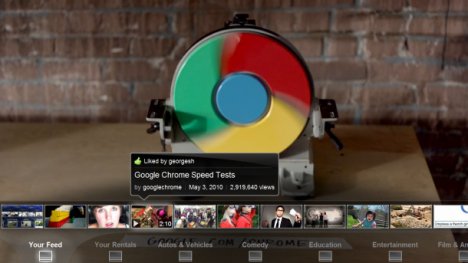
YouTube has officially rolled out YouTube Leanback, a layout previewed a while back that is designed for 10-foot viewing on TVs where a long viewing distance is necessary. The interface removes the comments and many other distracting visuals while making important features easily accessible. Folks who use Google TV hardware will have the option of setting devices like the Logitech Revue or Sony Internet TV to use Leanback the first time they load YouTube from the regular interface. Such a move will definitely help YouTube become commonplace in the living room. Video after the jump.

Sunday, October 10, 2010

Watch All World Cup 2010 Stadiums In 3D Via Google Earth

The World Cup 2010 is due to being in South Africa on June 11th and millions of fans around the globe will watch 64 group matches as well as the elimination rounds. The games will be played on ten stadiums and all of them are simply astonishing. Most of us will not be able to attend the World Cup therefore Google has decided to offer us a 3D tour to all stadiums in South Africa.
All you need is to download Google Earth on your computer and you can do that from here. After that you should open the 3D models of the World Cup stadiums in Google Earth and you can do it from here. Among the coolest stadiums in South Africa you can find the Green Point Stadium, Moses Mabhida Stadium, and Soccer City Stadium.
This is an opportunity that shouldn’t miss so hit the link above and prepare for the World Cup! Well, it’s going to be a long month so say goodbye to your family, kids, and say hello to your friends and tons of beer! In the meantime check the video below and let us know if you like football or not!
Eliss Park - World Cup Stadium

Wednesday, October 6, 2010

Google Chrome 7 beta adds Google Instant, GPU acceleration

Google late Thursday quietly posted its first beta of Chrome 7. The release is the first to implement Google Instant and will optionally update search results from the main search bar, not just from the Google website. Graphics acceleration now plays a much larger role and both speeds up some CSS transforms and turns on WebGL support for plugin-free 3D.
Most changes are universal, but Mac users now get an optional Expose-style visual view of all tabs that they can trigger with a three-finger swipe if they use a trackpad. Windows users get a rough equivalent that only shows the tabs in a sidebar.

The interface features usually need to be exposed by using the "about:labs" command in the address bar, but some are likely to be active by default by the time Chrome 7 reaches its final, stable version. Google is promising new revisions about every six weeks. [via
CNET]

Google, Verizon to unveil 4G devices at CES

Verizon's wireless chief Lowell McAdam dropped more hints during his presentation at CTIA today with claims that there would be Android devices running 4G at the Consumer Electronics Show in January. He mentioned that there would be "some products" unveiled with Google CEO Eric Schmidt also on stage. Smartphones and tablets would likely be part of proceedings, McAdam said.
He didn't name what would arrive, but the resulting products were also due to ship sometime in the first half of 2011.

The most likely candidate so far is the Motorola Stingray, a 10-inch tablet that might be hardware upgradeable to 4G and use an NVIDIA Tegra 2 chip to support 1080p video playback. Other candidates include the ICD Ultra and an HTC tablet, although no mention has been made of 4G for the HTC hardware.

The addition of LTE-based 4G may give Android a technical edge over the iPad depending on whether or not Apple supplies Verizon devices of its own. It can run at up to 12Mbps downstream and has both the high upload speeds and low latency to make tasks possible on cellular that aren't options for 3G, such as streaming HD video or live two-way games and video chats.

Tuesday, October 5, 2010

Ad Companies Excited Over Google TV [Google TV Anticipated By Ad Firms, But Do We Want Internet On Our TV?] Posted May 24th 2010 by Kevin Schram under Audio,Visual | HD Equipment Read: Ad Companies Excited Over Google TV [Google TV Anticipated By Ad Firms, But Do We Want Internet On Our TV?]

After Google TV was announced at the Google I/O conference. The deal between Google, Intel, Sony and Logitech had been leaked months ago, but now that it’s out in the open, reactions from ad firms has come in – and they love it. Bloomberg BusinessWeek reports that ad firms are excited for Google TV’s interactive ads, with one telling them “It’s the future of advertising.”
googletv
In case you missed it, Google TV is Google’s new television initiative that will see further web connectivity added to the TV, both through Sony TVs and a Logitech set-top box for those of us with existing TVs. Unlike the current “Internet-connected” TVs, which usually run just widget-based apps, Google TV is looking to ‘unleash’ the user, so to speak. It’ll be based on Android, and will feature a full Chrome web browser, capable of full desktop Flash.
What does this have to do with ads? When a Google TV watches an ad, the user can instantly be redirected to the webpage for that company. This is basically the “HyperText TV” that we’ve seen in science fiction for years. Ad firms also like it, because like web ads, they can get an instant and accurate count on how many users viewed their ads (unlike traditional TV and radio ratings, which have always used selective samples and estimations. It’s always baffled me that networks sell ads for millions of dollars based on a sampling of viewers).
In addition to that, ad firms hope that Google’s internet heritage will drive the cost of TV ads down. As BBW reports, current TV ads can cost in the thousands or millions. According to BBW, the going CPM rate for online video on the web is about $30 – much lower than the going TV rate.
But, do we want internet on our TV? The widgets that came on the Yahoo-connected TVs and other internet services were simple and easy to use from ten-feet. Do we want a full web browser on your TV?

Google to Launch Google Audio Music Store on October 28? [Google to Work with iLike and Lala on New Google Audio Music Service] Posted October 21st 2009 by Chris Smith under Audio,Visual | Mp3 Players & PMPs | Personal Devices Share Read: Google to Launch Google Audio Music Store on October 28? [Google to Work with iLike and Lala on New Google Audio Music Service]

google ilike lala
Do we need a new music service? Don’t we have enough solutions to satisfy our needs? Google apparently thinks that it absolutely has to go into the music business too. That’s why the company will launch a new service, Google Audio, which should be available on October 28.

Google is working with iLike and Lala in order to deliver the new music service. The official release is scheduled for next Wednesday during a Hollywood event hosted by Lala and iLike called “Discover Music!”. Besides iLike and Lala there are “others” hosting it too. That’s right, you guessed it, Google seems to be one of those lucky others.

There are no precise details about Google Audio at this point as it looks like the new service has been kept secret quite successfully. Rumors say that Google Audio will let you search for your favorite songs and then stream them directly from Google. That’s where iLike and Lala will play their role apparently. Google will offer additional information concerning music queries which means you’re probably going to get a lot of extra stuff about your favorite songs and bands. And yes, music downloads will be available as long as you pay the price.
So who is iLike and Lala and why did Google join forces with them? iLike has been acquired by MySpace and it used to offer limited streaming services. It has some full streaming support and it offers 30 second clips. We expect MySpace Music to play an important part in this venture particularly because it has full streaming rights from the four major music labels. Lala will also stream music to you. The company lets you stream a song once and then you have to pay to get the same song again.
So what do you have to say about this Google, iLike, Lala and MySpace initiative? Are you going to ignore iTunes in favor of Google Audio? What music streaming services do you currently use and why? As you can see we have quite a few questions for you. Hit us up in comments and share your vision on streaming music services!

Google, Sony, Intel Preparing Google TV [Leak Reveals That Google Is Expanding To Internet-Connected HDTVs, Will Bring Widgets, Apps To Read: Google, Sony, Intel Preparing Google TV [Leak Reveals That Google Is Expanding To Internet-Connected HDTVs, Will Bring Widgets, Apps To TVs]

Google, Intel, Sony and Logitech are working together on a new deal that will bring Google to new HDTVs and set-top boxes. While we reported last week that Google was coming to Dish Network set-top boxes, the deal with Sony seems to be much bigger. When Google enabled-HDTVs hit the market, users will be able to run web applications from their TV.
Sony Bravia With Google chrome
This isn’t an entirely new concept. Various TV manufacturers have started this and Yahoo has been providing “Yahoo-connected TVs” for some time that allows Ethernet-connected HDTVs to run web apps from Twitter, Facebook, etc.
Google is working on the deal with Intel, Sony and Logitech. This info comes from a “source familiar with the situation” who spoke to the New York Times. When asked, all companies denied knowledge or declined to comment. The Times reports that these “Google TVs” would be running Android and they would let users watch web content, like YouTube or Hulu. Google TV will also include a version of the Chrome browser, so they can surf the web from their TV.
Logitech was asked to join the project because of their history with powerful universal remotes, and they’re said to be constructing a QWERTY keypad-equipped remote control for Google TV-enabled devices. One assumes that Sony would be producing the actual TV sets, while Intel could be producing the internal workings for the Google TV.
The New York Times reports that this is the beginning of Google’s attempts to get their Android footholds into different markets. They’re hoping that Google TV-enabled HDTVs will compete not only with the Yahoo Internet enabled HDTVs, but also with Roku and Boxee media center devices.
No word on when this “Google TV” project will be announced, or when we could expect to see Google TVs on shelves.

Share

Twitter Delicious Facebook Digg Stumbleupon Favorites More